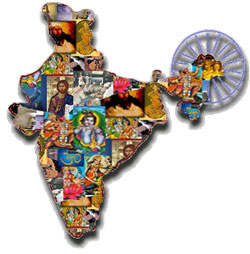
In fact, the ancients strove for unity. They looked upon this vast subcontinent as one land. The name Bharatavarsha or the land of Bharata was given to the whole country, after the name of an ancient tribe called the Bharatas. Our ancient poets, philosophers and writers viewed the country as an integral unit. This kind of political unity was attained at least twice during the Mauryan and Gupta Empires.
The unity of India was also recognized by foreigners. They first came into contact with the people living on the Sindhu or the Indus, and so they named the whole country after this river. The word Hind is derived from the Sanskrit term Sindhu, and in course of time the country came to be known as ‘India’ in Greek, and ‘Hind’ in Persian and Arabic languages.
Efforts for the linguistic and cultural unity of the country were made through the ages. In the third century B.C., Prakrit language served as the lingua franca of the country. Throughout the major portion of India, Asoka’s inscriptions were written in the Prakrit language. Also, the ancient epics, the Ramayana and the Mahabharata, were studied with the same zeal and devotion throughout the country. Originally composed in Sanskrit, these epics came to be presented in different local languages. Although the Indian cultural values and ideas were expressed in different forms, the substance remained the same throughout the country.
Hence, India has emerged a multi-religious and multi-cultural society. However, the underlying unity and integrity and the plural character of Indian society remain the real strength for the development of the country.